Nasal Nitric Oxide: What It Is, Why It Matters, and How Proper Nasal Breathing Supports Its Natural Benefits

If you’ve ever been told “breathe through your nose,” you were getting more than a comfort tip. Nasal breathing delivers a home-made protective gas—nasal nitric oxide (nNO)—from your nose and sinuses into the air you inhale. This tiny molecule helps your airways defend against germs, supports the movement of mucus, and even assists oxygen transfer in the lungs. In this comprehensive UK-focused guide for adults and parents, we explain exactly what nasal nitric oxide is, why it matters for day-to-day health, how proper nasal breathing affects its availability, and practical ways to support it at home and with your healthcare team.
Everything here is grounded in up-to-date research and UK clinical guidance. You’ll find plain-English explanations, clear take-aways, image prompts you can use to brief an illustrator or design tool, and links to further support at breathefirst.co.uk.
Table of Contents
What it is Nasal nitric oxide (nNO)?
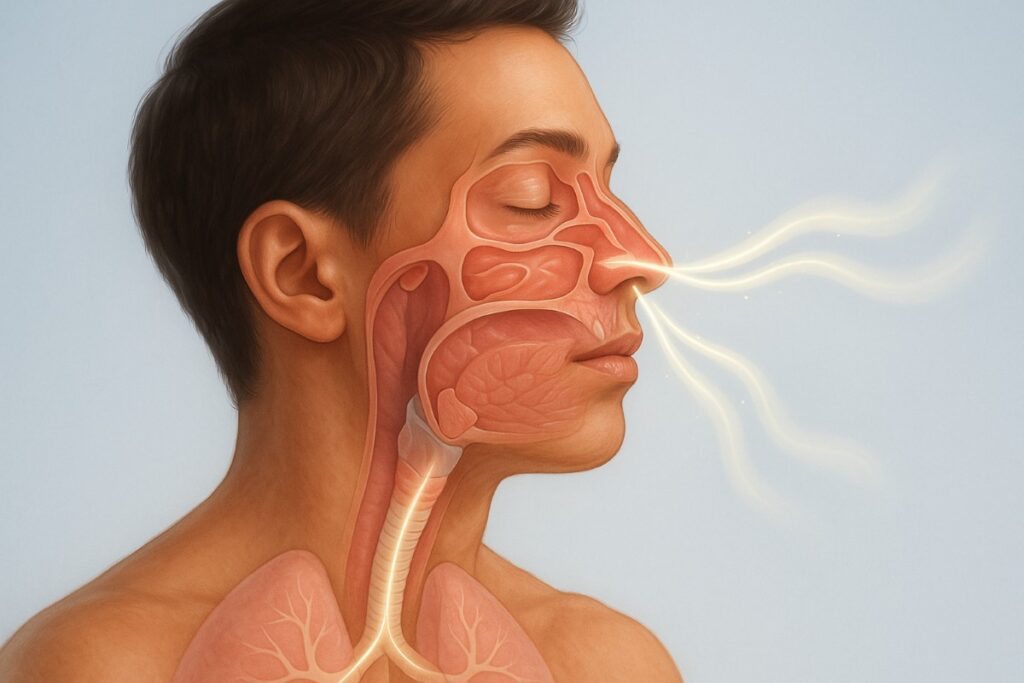
Nasal nitric oxide (nNO) is a natural gas continuously produced in the lining of your nose and paranasal sinuses. It’s part of the same nitric oxide family discussed in cardiology and sports physiology, but the concentrations in the upper airway are especially high, with the paranasal sinuses acting like a local “reservoir.” From there, nNO mixes into air during nasal breathing and flows down into the throat and lungs, where it can exert antimicrobial, mucosal-clearing and blood-flow effects. In contrast, mouth breathing bypasses this delivery route. Reviews over the past few years summarise that nNO is physiologically important in airway regulation and host defence, and that sinus openings (ostia) and airflow patterns strongly influence how much nNO reaches the main nasal airway. (Spector/Rhinology Online, “Nasal nitric oxide flux from the paranasal sinuses,” link; Spector/Curr Opin Allergy Clin Immunol, “Nasal nitric oxide flux from the paranasal sinuses,” link).
Clinically, nasal nitric oxide is also used as a marker in certain conditions. The European Respiratory Society (ERS) issued a 2023 technical standard for measuring nNO in children when investigating primary ciliary dyskinesia (PCD), a rare genetic disorder of the airway’s microscopic hairs (cilia). In PCD, nNO values are typically very low, which helps specialists decide when further in-depth testing is needed. (Beydon/European Respiratory Journal, “Nasal nitric oxide measurement in children for the diagnosis of primary ciliary dyskinesia: ERS technical standard,” link).
How common nasal nitric oxide is?
Nasal nitric oxide isn’t rare or exotic—it’s universal physiologically in people with healthy nasal and sinus linings. What varies from person to person are the levels recorded by specialist devices, which depend on age, measurement technique, and nasal health. For context, classic paediatric data in healthy children aged 6–17 years show mean values near 450 parts per billion (ppb) using standardised aspiration techniques, with wide normal ranges. More recent datasets from large paediatric cohorts using modern equipment are broadly similar. (Struben/European Respiratory Journal, “Nasal NO: normal values in children,” link; Wu/Frontiers in Pediatrics 2023, “Nasal NO in healthy children 6–18 yrs,” link).
In infants, values start lower and rise with age as sinuses and nasal passages mature. A 2023 review summarised longitudinal data showing median newborn nNO around 46 ppb, increasing by approximately 5.4% per month to a median of 283 ppb by age two. (Paternò/International Journal of Molecular Sciences, “Role of Nasal Nitric Oxide in Primary Ciliary Dyskinesia,” link).
Conditions that alter nNO are themselves common. In UK adults, symptom-defined chronic rhinosinusitis (CRS) affects roughly one in ten people. CRS with polyps (CRSwNP) is a subset often associated with reduced nNO, likely because inflamed tissue and blocked ostia limit nNO mixing from the sinuses. (NICE CKS, “Sinusitis—prevalence,” link; Min/Clin Exp Allergy 2024, “Global prevalence of CRS,” link).
Allergic rhinitis—another major driver of nasal dysfunction—affects about 26% of UK adults and 10–15% of children, with seasonal peaks that disrupt sleep, school, and work. During allergic flares, nNO can be higher in some people due to inflammation and enzyme up-regulation, but when swelling blocks sinus drainage, measured nNO may be lower. The key practical point is that healthy, clear nasal airflow supports normal nNO delivery into each breath. (Allergy UK, “Statistics and Figures,” link; Marcuccio/Journal of Clinical Medicine 2023, “Clinical applications of nNO in allergic rhinitis,” link).
Why nasal nitric oxide matters for your health
Natural antimicrobial action and mucosal defence.
Nitric oxide has broad antimicrobial properties across bacteria, fungi and viruses in laboratory and translational models. In the nose and paranasal sinuses, locally generated nNO contributes to first-line defence, helping to limit pathogen growth and supporting ciliary beating—the coordinated, hair-like movement that drives mucus clearance. Reviews over the last five years emphasise NO’s direct and indirect antiviral actions and its role in modulating host immune responses. While therapeutic NO (e.g., donor sprays or inhaled NO) is still being studied for viral illnesses, your own nasal tissues quietly generate and deliver nNO every time you breathe through your nose. (Garren/Antiviral Research 2020, “NO and viral infection,” link; Zhang/Middle East Gas Association Review 2024 & 2023 preprint family, “Saying no to SARS-CoV-2,” link; Marcuccio/J Clin Med 2023, “Clinical Applications of nNO in Allergic Rhinitis,” link).
Airflow regulation and oxygen handling
Nitric oxide relaxes smooth muscle in blood vessels (a vasodilator effect). In the lungs, NO can improve matching between ventilation and blood flow, which in turn can support oxygen exchange. Several physiological and clinical lines of evidence suggest that nasal delivery of NO with each nose breath helps condition the inhaled air and may contribute to efficient gas exchange. While therapeutic inhaled NO is a specialist hospital treatment for specific conditions (and not something for home use), the concept underscores why nasal breathing feels “smoother” and often more satisfying than mouth breathing. Contemporary reviews on upper airway NO describe these respiratory roles alongside host defence. (Spector/Rhinology Online 2022, “nNO flux from paranasal sinuses,” link; Spector/Current Opinion in Allergy & Clinical Immunology 2023, link).
Sleep, snoring, and daytime comfort
When the nose is blocked—because of allergies, a cold, or chronic rhinosinusitis—people tend to mouth breathe, which bypasses the nasal passages and their supply of nNO. Parents often notice more snoring, dry mouth, and unsettled sleep in these periods. UK resources recognise that treating nasal obstruction (for example, optimising allergy care or, in selected cases, considering adenoid surgery in children) can improve nasal airflow, reduce mouth breathing, and support healthier sleep. (NHS, “Adenoidectomy,” link; GOSH, “Your child having tonsils and/or adenoids removed,” link).
What nitric oxide levels can reveal about health
Persistently very low nNO is characteristic of most people with primary ciliary dyskinesia. ERS technical standards now detail how to measure nNO in children to support PCD case-finding and referral. Low nNO is also reported in some cases of cystic fibrosis and when sinus ostia are obstructed (as in CRSwNP), whereas allergic rhinitis may show normal or even elevated nNO depending on inflammation and technique. The key takeaway: nNO is a useful indicator inside specialist pathways, not a home test. (Beydon/ERS Tech Standard 2023, link; Kobal/Children 2023, “nNO in children: review,” link; Wu/Allergy & Rhinology 2024, “nNO and NOS expression in CRSwNP,” link).
Inside the Nose: Where Nasal Nitric Oxide Comes From
Your nose connects to air-filled spaces in the skull called the paranasal sinuses—maxillary, ethmoid, frontal and sphenoid. These sinuses open into the nasal cavity through narrow channels called ostia. Epithelial cells lining the nasal passages and sinuses express nitric oxide synthase (NOS) enzymes that generate NO. Because sinus NO concentrations are especially high, the sinuses function as a reservoir that releases nNO into the main nasal airway, where it is entrained in inhaled air during nasal breathing. If ostia are blocked—by swelling, polyps, or mucus—less nNO can mix into the airflow. (Spector/Rhinology Online 2022, link; Spector/Curr Opin Allergy Clin Immunol 2023, link).
Research teams have even demonstrated how simply changing the way we move air through the nose can modulate nNO mixing: humming during a nasal exhalation creates pressure oscillations that markedly increase measured nasal NO, likely by enhancing exchange between sinuses and the nasal cavity. It’s a helpful illustration that airflow dynamics—and therefore nasal breathing technique—matter for the delivery of nNO. (Lundberg/JAMA, “Humming, Nitric Oxide, and Paranasal Sinus Obstruction,” link).
Finally, nNO has downstream effects. NO can relax pulmonary vessels, helping to better match blood flow to well-ventilated lung areas, which is one reason inhaled NO is used as a hospital treatment in select conditions. Day to day, none of us needs bottled NO gas—our own sinuses provide a steady supply when we breathe through the nose. (Spector/Rhinology Online 2022, link).
Benefits of the recommended/healthy behaviour (nasal breathing and nasal care)
Clearer breathing and comfort. Nasal breathing naturally warms, humidifies and filters air, while also delivering nNO to the lower airways. Many people notice smoother, quieter breaths and less throat dryness when they can keep the nose open and functional, especially overnight.
Support for airway defences. By ensuring airflow through the nasal passages, you help distribute nNO and maintain healthy mucus-clearing (mucociliary) function—your body’s built-in conveyor belt for dust, pollen and microbes. Air that has passed through the nose is not only conditioned but also accompanied by an endogenous antimicrobial “escort.” (Marcuccio/J Clin Med 2023, Clinical Applications of nNO in Allergic Rhinitis, link).
Better sleep habits and less mouth dryness. People who manage nasal symptoms often report reduced snoring, less waking with a dry mouth, and more restorative sleep. In children, addressing nasal blockage and promoting nasal breathing can contribute to calmer nights and brighter mornings. Where enlarged adenoids are a factor, UK ENT resources outline when surgical options are considered, alongside conservative care. (NHS, “Adenoidectomy,” link; GOSH, “Obstructive sleep apnoea in children,” link).
Nasal nitric oxide (nNO) is a protective gas made in the nose and sinuses. During nasal breathing, it mixes into inhaled air and helps fight microbes, supports mucus clearance, and assists oxygen handling in the lungs. Conditions that block the nose (allergic rhinitis, sinusitis, nasal polyps) can reduce nNO delivery; allergic inflammation may sometimes raise measured levels, whereas primary ciliary dyskinesia shows characteristically very low values. Keeping the nose clear—via saline rinses, appropriate intranasal steroid sprays, and allergy management—supports nasal breathing and the body’s own nNO system. (Spector/Rhinology Online 2022, link; Beydon/ERS 2023, link; Marcuccio/J Clin Med 2023, link; NICE CKS Sinusitis, link).
What affects nasal nitric oxide levels and delivery
Allergic rhinitis (hay fever and perennial allergies). Allergic inflammation can increase NO production through inducible NOS pathways, sometimes leading to higher measured nNO. But nasal swelling and mucus can also impair sinus ventilation; on any given day, a congested person may deliver less of their reservoir nNO into breaths simply because air isn’t passing effectively through the nose. UK prescribing and practice guidance recognises intranasal corticosteroids as first-line for moderate to severe symptoms and as a mainstay of long-term control, with NICE CKS offering dose and product advice. (BSACI SOP 2023, “Topical Nasal Corticosteroid Spray,” pdf; NICE CKS, “Allergic rhinitis,” link).
Chronic rhinosinusitis (CRS) with or without nasal polyps. CRS is common in UK adults and often features persistent congestion, facial pressure, and reduced smell. CRSwNP tends to be associated with lower measured nNO because polyp tissue and blocked ostia reduce the mixing of sinus NO into inhaled air. Effective CRS management aims to restore patency and reduce inflammation, which can normalise airflow and nNO delivery. (NICE CKS Sinusitis—prevalence and background, link; Wu/Allergy & Rhinology 2024, “nNO and NOS in CRSwNP,” link).
Primary ciliary dyskinesia (PCD) and related conditions. PCD typically presents with chronic wet cough, early-onset ear/sinus disease, neonatal respiratory distress, and laterality issues in some patients. nNO testing (in children able to cooperate) is a valuable screening tool because values are consistently very low in most PCD, helping identify who needs definitive diagnostic testing. (Beydon/ERS Technical Standard 2023, link; Shapiro/Frontiers 2020, “nNO in PCD diagnostic pathway,” link).
Temporary nasal infections and colds. Even short-lived viral colds swell the lining of the nose and narrow the ostia. That means less sinus ventilation and a temporary reduction in the effective delivery of nNO into each breath—even if the mucosa is making plenty of it. Symptom control and gentle nasal hygiene help you ride out these episodes while keeping airflow as nasal as possible. (NICE CKS Sinusitis—prevalence and overview, link).
Structural factors. A deviated nasal septum or enlarged turbinates reduce nasal cross-section and may limit airflow and sinus exchange. ENT evaluation can determine whether medical therapy, minimally invasive procedures, or surgery are appropriate when symptoms are persistent and quality of life is affected. (NICE CKS and UK ENT patient pathways referenced above).
Spotting the signs of reduced nasal nitric oxide
Because nNO itself isn’t something you can measure at home, focus on nasal function and the daily cues that suggest your nose isn’t doing its best work. Waking with a dry mouth, habitual mouth breathing (day or night), snoring that worsens with colds or pollen season, and a reduced sense of smell are classic flags that airflow through the nose is compromised. Parents may see school-age children sleeping with the mouth open, rubbing their noses, or sniffling frequently. Adults may notice that voice quality and throat comfort deteriorate when the nose is congested—as the air bypasses the normal conditioning and antimicrobial support of nasal breathing.
In children with frequent nasal blockage, UK patient information sheets explain that enlarged adenoids can contribute to mouth breathing, snoring and sleep disturbance; when symptoms are significant, adenoid surgery may be discussed within standard ENT pathways. Improving nasal airflow helps restore the delivery of nNO along with the other benefits of nasal breathing. (NHS, “Adenoidectomy,” link; GOSH, “Your child having tonsils and/or adenoids removed,” link).
Practical, evidence-based ways to support nasal nitric oxide at home
Keep the nose clear with saline
Saline irrigation (using isotonic or hypertonic saltwater) can reduce symptom severity in allergic rhinitis and chronic rhinosinusitis, with a low risk of side effects. The 2018 Cochrane review found that saline may improve symptoms versus no irrigation at up to three months, and more recent rapid evidence reviews note that irrigation tends to outperform simple sprays for symptom control. Think of it as a gentle, mechanical way to wash away allergens, pollutants and excess mucus, maintaining patent ostia so that nNO can mix into airflow. (Cochrane/Head 2018, “Saline irrigation for allergic rhinitis,” link; AAFP Rapid Evidence 2023, “Allergic rhinitis,” link; Allergy, Asthma & Clinical Immunology 2024, “Allergic rhinitis review—saline improves symptoms and QoL,” link).
Use intranasal corticosteroid sprays correctly when indicated
For moderate to severe allergic rhinitis or persistent nasal obstruction, UK guidance recommends intranasal corticosteroids as first-line. They reduce swelling, improve airflow, and—indirectly—help restore effective nNO delivery during nasal breathing. Technique matters: aim slightly outwards, not at the septum; use daily during allergy seasons or long-term for perennial symptoms as advised. (BSACI 2023 SOP, “Nasal Corticosteroid Spray,” pdf; NICE CKS, “Allergic rhinitis—intranasal corticosteroids,” link).
Re-train gentle nasal breathing habits.
Once airflow is comfortable, practise slow, quiet nasal breathing during the day—“lips together, tongue resting on the palate.” For some adults, a brief period of daytime “humming” breaths (softly, through the nose) can act as a reminder and demonstrate how the nose feels when air moves well; humming transiently increases measured nasal NO by enhancing sinus exchange. Avoid taping a child’s mouth at night; focus on nasal patency and age-appropriate routines instead. (Lundberg/JAMA 2003, “Humming and nasal NO,” link).
Plan for pollen and trigger.
If you’re a hay fever household, start steroid sprays one to two weeks before your usual pollen season and maintain them regularly during exposure, as UK primary care pathways advise. Pair this with daily saline in high-pollen periods and sensible avoidance (windows closed on very high pollen days, sunglasses outdoors, shower after outdoor play). (NHS & UK primary care AR pathways; NICE CKS Allergic rhinitis overview, link).
Make your bedroom air “nose-friendly.”
Cool, slightly humid air (not damp) reduces nasal dryness. Avoid strong scents or smoke exposure. If snoring and mouth breathing persist despite good nasal care, especially in a child, speak to your GP about ENT assessment. (NHS, “Adenoidectomy,” link).
For practical how-tos (including step-by-step spray technique and simple daily nasal-care routines), explore the guides and services at breathefirst.co.uk. We keep resources parent-ready and jargon-light so you can act with confidence.
Professional care in the UK: when to seek help and what to expect
Start with your pharmacist or GP for common nasal symptoms. Pharmacists can advise on over-the-counter saline, antihistamines and intranasal corticosteroids. Your GP can confirm whether symptoms fit allergic rhinitis, chronic rhinosinusitis or another cause, and whether a trial of regular intranasal steroids plus saline is appropriate. NICE CKS offers dosing and product selection detail for primary care. If symptoms persist beyond 2–4 weeks of steady use or there are red flags (unilateral blockage, significant nosebleeds, facial pain with fever), your GP may consider further work-up or ENT referral. (NICE CKS, “Allergic rhinitis,” link; NICE CKS, “Sinusitis,” link).
ENT assessment for persistent obstruction, polyps, or sleep-related symptoms. ENT teams evaluate septal deviation, turbinate hypertrophy, adenoid size (in children) and polyps. Management aims to restore airflow (medical therapy first, surgery where appropriate), which supports all the physiological benefits of nasal breathing—including effective nNO delivery. Children with significant snoring or obstructive sleep apnoea (OSA) symptoms may be evaluated for adenotonsillectomy according to UK pathways; this can improve nasal breathing and sleep quality. (NHS, “Adenoidectomy,” link; GOSH, “OSA in children,” link).
When specialists measure nasal nitric oxide. nNO testing is not a general screening test; it’s used in specific diagnostic pathways, chiefly to support case-finding for PCD in children and adults able to cooperate with manoeuvres. The 2023 ERS technical standard sets out how to measure and interpret nNO alongside other tests. Importantly, low nNO suggests the need for specialist evaluation—it doesn’t make the diagnosis on its own. (Beydon/ERS 2023 Technical Standard, link; Raidt/Annals ATS 2022, “Limitations of nNO measurement,” link).
Allergy services and immunotherapy. People with confirmed allergic rhinitis that remains troublesome despite best medical therapy may discuss allergen immunotherapy with an allergy specialist. Reducing allergic burden improves nasal patency and comfort, indirectly supporting nasal breathing and nNO transport. UK allergy organisations (BSACI) and local integrated care boards provide up-to-date pathways and commissioning criteria. (BSACI resources 2023–2024; examples include BSACI SOP for intranasal steroids, pdf).
For signposting and coaching that dovetails with NHS care—saline routines, spray technique, habit support—visit breathefirst.co.uk. We can also help you prepare questions for your next GP or ENT appointment.
FAQs
What exactly does nasal nitric oxide do for me day to day?
It supports your nose’s natural defences. nNO has antimicrobial effects and stimulates ciliary beating, helping to move mucus and trapped particles out of the nose and sinuses. It also contributes to smooth airflow and may assist gas exchange once it reaches the lungs. You don’t need to supplement it; by keeping the nose clear and breathing through it, you deliver nNO into every breath. (Garren/Antiviral Research 2020, link; Spector/Rhinology Online 2022, link).
Can I increase nNO by “training” my breathing?
You can’t force your cells to make infinite NO, but you can improve delivery. Nasal breathing ensures the nNO made in your sinuses joins the airstream, while mouth breathing bypasses it. Simple humming during nasal exhalation momentarily boosts measured nNO by enhancing sinus–nasal exchange, which is a neat demonstration that airflow dynamics matter. But the best long-term strategy is to keep nasal passages healthy and open. (Lundberg/JAMA 2003, link; Marcuccio/J Clin Med 2023, link).
My child mouth breathes at night. Does that mean low nNO?
Not necessarily—nNO production in the nose and sinuses may be normal, but mouth breathing bypasses those passages so less nNO is delivered into the breath. Focus first on why mouth breathing is happening: common culprits are colds, allergic rhinitis, and enlarged adenoids. Your GP can help, and ENT may be involved if symptoms persist. (NHS, “Adenoidectomy,” link; NICE CKS Allergic rhinitis, link).
Are there supplements or sprays that raise nasal nitric oxide?
Various nitric-oxide-related products are being studied, including donor compounds and inhaled NO in hospitals for specific conditions. Some small trials (e.g., NO-releasing nasal sprays) are promising for particular infections, but these are not general over-the-counter solutions for airway health. For everyday wellness, the evidence supports basic nasal care and allergic rhinitis control to maintain nasal breathing. (Tandon/Lancet Regional Health—Southeast Asia 2022, “NO nasal spray and SARS-CoV-2 RNA reduction,” link; Spector/Rhinology Online 2022, link).
Should I ask for a nasal nitric oxide test?
nNO testing is reserved for specific clinical questions, most notably when a specialist suspects primary ciliary dyskinesia. It’s not a general wellness test. If you or your child have chronic nasal symptoms, the first steps are symptom management, allergy assessment if relevant, and ENT review if obstruction persists. Specialists decide whether nNO measurement is appropriate. (Beydon/ERS 2023 Technical Standard, link).
Does exercise change nasal nitric oxide?
Moderate exercise can improve nasal patency for many people by reducing mucosal congestion temporarily, which may improve the delivery of nNO simply by favouring nasal airflow. Research directly assessing changes in nNO with exercise in healthy people is mixed and context-dependent; the practical advice remains to keep exercising regularly and aim for nasal breathing when comfortable and safe. (Narrative synthesis from airway physiology literature and reviews cited above).
Taking the next steps for healthier nasal breathing
Think of your nose as a smart entry hall for your lungs. When it’s open and comfortable, every nasal breath carries a dose of nitric oxide from the sinuses—nature’s own airway-support gas—alongside warmed, filtered, humidified air. That combination helps clear mucus, defend against microbes, and support comfortable, efficient breathing. If congestion, allergies, or chronic sinus issues are getting in the way, small, steady steps can make a big difference: regular saline, correct use of intranasal steroids when indicated, and simple habit-building for nasal breathing.
If you’d like a practical plan—spray technique, rinse routines, family-friendly habit cues—or help coordinating with your GP, ENT or allergy services, visit breathefirst.co.uk. We offer down-to-earth guides and support so you can put evidence into action, sleep better, and breathe easier—one good nose breath at a time.
Citations
- (Spector BM et al., Nasal nitric oxide flux from the paranasal sinuses, Rhinology Online, 2022) https://pmc.ncbi.nlm.nih.gov/articles/PMC10170969/
- (Spector BM, Nasal nitric oxide flux from the paranasal sinuses, Curr Opin Allergy Clin Immunol, 2023) https://pubmed.ncbi.nlm.nih.gov/36373691/
- (Beydon N et al., Nasal nitric oxide measurement in children for the diagnosis of primary ciliary dyskinesia: ERS technical standard, Eur Respir J, 2023) https://publications.ersnet.org/content/erj/61/4/2202031
- (Mrkić Kobal I et al., Nasal Nitric Oxide in Children: A Review of Current Knowledge, Children, 2023) https://pmc.ncbi.nlm.nih.gov/articles/PMC10605182/
- (Struben VMD et al., Nasal NO: normal values in children 6–17 years, Eur Respir J, 2005) https://publications.ersnet.org/content/erj/26/3/453
- (Wu Y et al., Reference range of nasal nitric oxide in healthy children 6–18 years, Frontiers in Pediatrics, 2023) https://www.frontiersin.org/journals/pediatrics/articles/10.3389/fped.2023.990510/pdf
- (Paternò S et al., Role of Nasal Nitric Oxide in Primary Ciliary Dyskinesia, Int J Mol Sci, 2023) https://www.mdpi.com/1422-0067/24/22/16159
- (NICE CKS, Sinusitis—prevalence and background, updated) https://cks.nice.org.uk/topics/sinusitis/background-information/prevalence/
- (Min HK et al., Global Incidence and Prevalence of Chronic Rhinosinusitis, Clin Exp Allergy, 2024) https://pubmed.ncbi.nlm.nih.gov/39506931/
- (Allergy UK, Statistics and Figures—Allergic rhinitis prevalence) https://www.allergyuk.org/about-allergy/statistics-and-figures/
- (Marcuccio G et al., Clinical Applications of Nasal Nitric Oxide in Allergic Rhinitis, J Clin Med, 2023) https://www.mdpi.com/2077-0383/12/15/5081
- (Lundberg JO et al., Humming, Nitric Oxide, and Paranasal Sinus Obstruction, JAMA, 2003) https://jamanetwork.com/journals/jama/fullarticle/195781
- (BSACI, Topical Nasal Corticosteroid Spray—Standard Operating Procedure, 2023) https://www.bsaci.org/wp-content/uploads/2023/11/Nasal-corticosteroid-SOP-BSACI.pdf
- (NICE CKS, Allergic rhinitis—intranasal corticosteroids) https://cks.nice.org.uk/topics/allergic-rhinitis/prescribing-information/intranasal-corticosteroids/
- (Head K et al., Saline irrigation for allergic rhinitis, Cochrane Review, 2018) https://pubmed.ncbi.nlm.nih.gov/29932206/
- (Weaver-Agostoni J et al., Allergic Rhinitis: Rapid Evidence Review, AAFP, 2023) https://www.aafp.org/pubs/afp/issues/2023/0500/allergic-rhinitis.html
- (Allergy, Asthma & Clinical Immunology, Allergic rhinitis—review, 2024) https://aacijournal.biomedcentral.com/articles/10.1186/s13223-024-00923-6
- (NHS, Adenoidectomy) https://www.nhs.uk/tests-and-treatments/adenoidectomy/
- (GOSH, Your child having tonsils and/or adenoids removed) https://www.gosh.nhs.uk/conditions-and-treatments/procedures-and-treatments/your-child-having-his-or-her-tonsils-andor-adenoids-removed/
- (GOSH, Obstructive sleep apnoea (children)) https://www.gosh.nhs.uk/conditions-and-treatments/conditions-we-treat/obstructive-sleep-apnoea/
- (Raidt J et al., Limitations of Nasal Nitric Oxide Measurement for Diagnosing PCD, Annals ATS, 2022) https://www.atsjournals.org/doi/full/10.1513/AnnalsATS.202106-728OC
- (Tandon M et al., Nitric oxide nasal spray and SARS-CoV-2, Lancet Regional Health—Southeast Asia, 2022) https://www.thelancet.com/journals/lansea/article/PIIS2772-3682(22)00046-4/fulltext
- (Garren MR et al., Nitric oxide and viral infection—review, Antiviral Research, 2020) https://pmc.ncbi.nlm.nih.gov/articles/PMC7718584/