Tongue Tie Release: Why Myofunctional Therapy Before and After Matters

In short: A tongue tie release (also called a frenectomy or frenuloplasty) frees the restricted tongue, but the surgery alone does not retrain how the tongue moves. Clinical evidence suggests the best functional results come from pairing the release with orofacial myofunctional therapy, both before and after the procedure.
Therapy before surgery prepares the muscles; therapy and active tongue exercises after surgery support healing, help keep the tongue mobile, and reduce the chance of the released tissue healing back together and reattaching. This applies to babies, children and adults. Therapy is an adjunct that improves the outcome of a release, not a standalone cure.
Table of Contents
What is a tongue tie, and what does a release involve?
Ankyloglossia, or tongue tie, is when the lingual frenulum (the band of tissue connecting the underside of the tongue to the floor of the mouth) is short or tight enough to restrict how the tongue moves. That restriction can cause a range of functional problems. In babies it is often linked to difficulty latching and feeding. In older children and adults it can contribute to problems with eating, speech, resting tongue posture, and in some cases snoring and sleep-disordered breathing [1][6].
A release, clinically a frenectomy or frenuloplasty, goes by many everyday names: tongue tie surgery, a tongue tie procedure or operation, having the tongue tie cut, or, in NHS settings, tongue tie division. Whatever it is called, the procedure frees the restriction by dividing or removing the tight tissue. It can be done with scissors or as a laser tongue tie release.
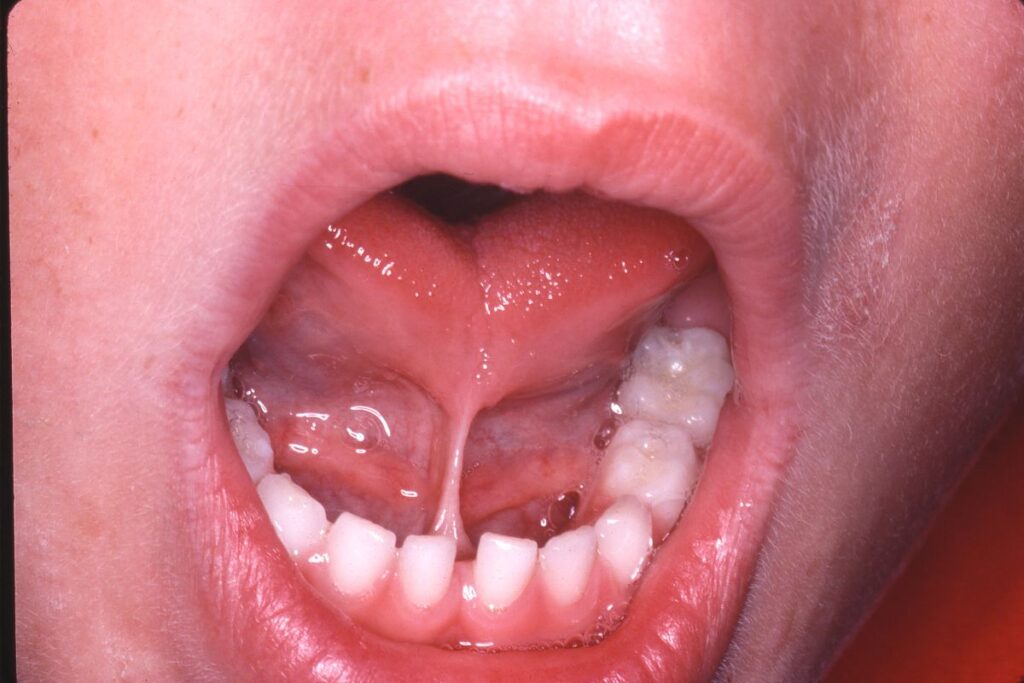
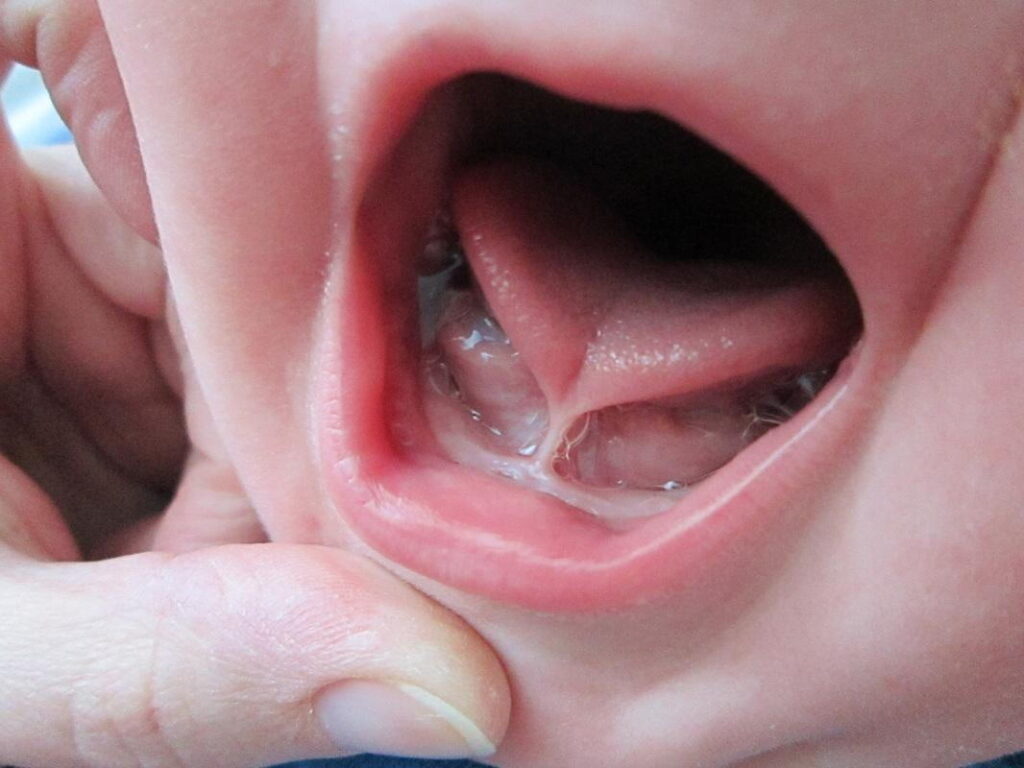
A tongue tie in a baby. The lingual frenulum, the band of tissue under the tongue, is tight enough to limit how far the tongue lifts and moves.
Tongue tie releases are carried out by dentists, ENT surgeons and trained specialist practitioners. In the UK, NHS treatment is most readily available for babies with feeding difficulties; for older children and adults, provision varies by area, so many people arrange the procedure privately. Freeing the tissue is an important step, but it does not by itself teach the tongue how to move well. The evidence is consistent that the procedure works best when it is paired with a structured programme of orofacial myofunctional therapy, rather than performed in isolation [1][6].
What orofacial myofunctional therapy actually is
Orofacial myofunctional therapy is exercise-based therapy for the muscles in and around the mouth. The exercises retrain the tongue, lips and related muscles to rest, breathe and swallow in healthier patterns [1]. You can read more about how we deliver myofunctional therapy at Breathe First, including what an assessment involves.
This matters because when a tongue has been restricted for years, other muscles in the jaw, neck and face tend to overwork to compensate. Over time those compensations can become their own problem. In professional voice users, for example, restricted tongue mobility has been linked to muscle tension dysphonia, a pattern of vocal fatigue and strain [3]. Therapy works by retraining the system: encouraging proper resting tongue posture, nasal breathing, and a correct swallow. Where mouth breathing and disturbed sleep are part of the picture, we may also draw on Buteyko breathing re-education alongside the myofunctional work.
Myofunctional therapy before a tongue tie release
Many practitioners recommend starting myofunctional therapy before the release itself. The reasoning is practical. After years of restriction the relevant muscles are often weak and used to moving in the wrong way, so a period of preparation builds awareness and begins strengthening and stretching the tongue before surgery. It also means the exercises are already familiar when the post-operative routine begins, which tends to make recovery smoother [6].
We should be honest that the evidence base here is more about sound clinical reasoning and protocol than large trials. It is a sensible, low-risk preparation, not a guaranteed outcome on its own.
Why therapy after a release matters more
Once the tissue is divided, the most important phase of functional recovery begins. The freshly released area heals like any wound, and it can heal back together, a process usually described as reattachment. Without active movement, the body’s natural healing can draw the tissue tight again, which may bring earlier symptoms back. Consistent, active use of the tongue during healing is what keeps the area mobile, lowers the chance of the tongue tie reattaching, and helps the tongue learn its new range [6].
Post-operative therapy usually continues the exercises started beforehand, beginning within days of the procedure and carrying on for several weeks. The aim is to help the tongue settle into proper resting and functional postures while the tissue heals [6].
We do not publish specific stretch protocols here, because the right regime depends on age, the procedure, and the individual. Your practitioner will set yours and adjust it as you heal.
After a release in babies
Infants cannot follow instructions, so a parent guides the movement. Clinical guidance describes gentle stretching and suck-training approaches a parent can use to support healing and feeding, always taught and supervised by the practitioner who carried out or oversaw the release [1][6]. If you are unsure what to do, ask before improvising.
Parents often ask how long after a tongue tie release feeding improves. Improvement is rarely instant. Feeding tends to settle as the area heals and the suck pattern is relearned, which is exactly why guided post-release support matters [6]. If feeding has not improved, or breastfeeding is still painful after the release, go back to the practitioner who carried it out for review rather than waiting it out.
After a release in adults and older children
Tongue tie is not only a baby’s problem. Plenty of adults live with an undiagnosed tie for years, and tongue tie symptoms in adults commonly include effortful speech, difficulty managing certain foods, jaw and neck tension, and in some cases snoring and disturbed sleep [1][6]. Because the restriction has always been there, being tongue tied as an adult often goes unrecognised until something else, such as dental work, voice problems or a sleep assessment, brings it to light.
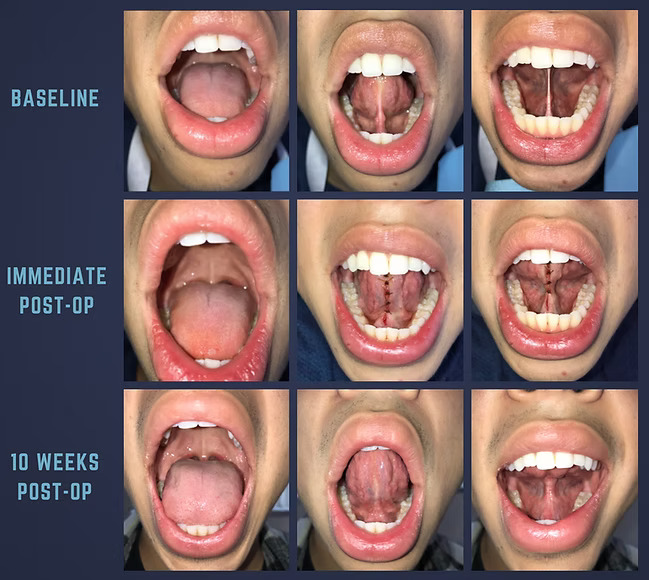
A tongue tie graded 3 (below average mobility) released to Grade 1 (above 80% mobility). The rows show baseline, immediately after the release, and 10 weeks later. The functional gain is clearest at 10 weeks, after the recovery period, which is why the work that happens during healing matters as much as the procedure itself.
Adults can have a tongue tie released, and an adult tongue tie release follows the same principle as in children: the procedure frees the tissue, and therapy retrains the function. For older children and adults, recovery takes conscious daily practice. Therapy typically combines tongue-elevation and mobility work with practising a correct swallow using the newly freed tongue [4][6]. Tongue tie exercises for adults follow the same principle as for children, retraining a tongue that has spent a long time compensating.
“A release frees the tissue, but it does not teach the tongue to lift, hold and move in the patterns it has been avoiding for years. That retraining is the real work.” Emily Kirkcaldy, Clinical Lead, Breathe First
People searching for adult tongue tie release before and after results usually find photographs of the tissue change. The change that matters is functional: easier tongue lift, a better swallow, and in some cases improvements in symptoms such as snoring and, in voice professionals with muscle tension dysphonia, reduced vocal fatigue and better stamina [3][4]. These are encouraging signals rather than guarantees, and individual results vary.
What the evidence does and does not show
It is worth being clear-eyed about the research. A systematic review of myofunctional therapy in ankyloglossia found there is not yet strong evidence that therapy alone, without a release, resolves a structural tongue tie. The physical restriction generally needs a physical release. The same review supports the combined approach: surgery plus therapy gives better functional results than surgery alone [1].
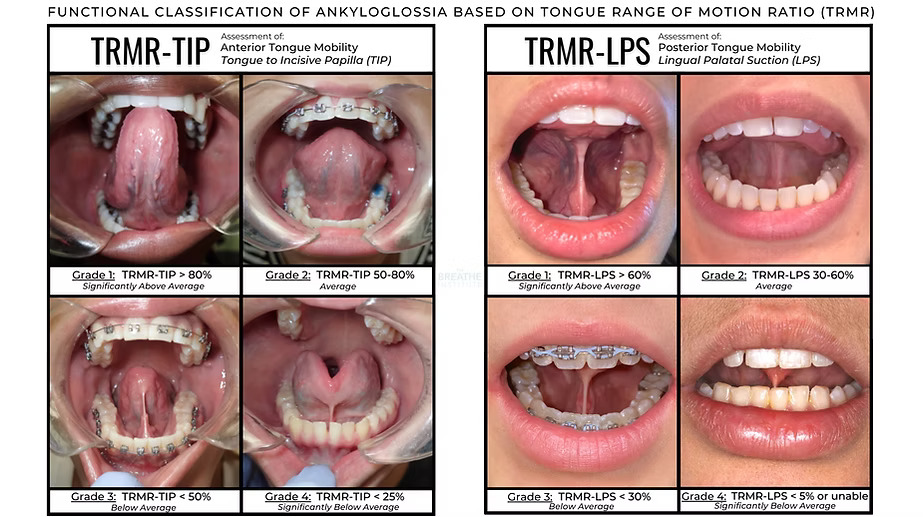
Clinicians can grade tongue tie by function rather than appearance. The Tongue Range of Motion Ratio (TRMR) scores anterior mobility (tongue to incisive papilla, TIP) and posterior mobility (lingual-palatal suction, LPS) from Grade 1, near normal, to Grade 4, significantly restricted. This is why two ties that look similar can affect function very differently.
So therapy is best understood as an adjunct that improves the outcome of the release, not a standalone cure. It asks for time, effort and consistency, and outcomes depend on individual anatomy and on how well the exercises are kept up.
The real challenge: keeping it up
The biggest obstacle in myofunctional therapy is not the exercises themselves, it is doing them every day. Adherence is a well-documented problem: across studies, sustained daily practice is hard to maintain, and that drop-off limits results [2][4]. Typical routines ask for several short sessions a day, which is a lot to hold onto for a busy adult or a parent managing a baby’s care. Finding ways to fold the movements into normal daily life is something we think about constantly in clinic.
Not sure where you are in the process? Whether you are weighing up a release, preparing for one, or recovering from a procedure that did not come with a plan for the tongue, we can help you work out the right next step. Arrange a discovery call or enquire about therapy and we will talk it through. We see adults and children, in person at our Altrincham and Lichfield clinics or online. You can also view our therapy services and pricing.
From our clinic: Emily Kirkcaldy, Clinical Lead
The following reflects Emily’s first hand professional experience and opinion, drawn from clinical practice. It sits alongside, not within, the research above.
In my clinic, the patients who struggle most after a release are the ones sent away with no plan for the tongue itself. A release frees the tissue, but it does not teach the tongue to lift, hold and move in the patterns it has been avoiding for years. That retraining is the real work, and it carries on at home between our sessions.
One tool I recommend is the REMplenish Myo Nozzle. Drinking water through it turns an ordinary habit into gentle tongue suction and a press against the palate, so the tongue is working in the upward, sealed posture we are trying to rebuild. I like it because the hardest part of home exercises is that people stop doing them, and this folds the practice into something they already do all day.
I am honest with patients that it is a strengthening and habit tool that supports therapy. It is not a fix on its own, and it is not a guaranteed way to prevent the tissue reattaching. What keeps the tongue mobile while the wound heals is consistent, active use, and the Nozzle is one easy way to keep that going.
How an at-home tool fits in
To put Emily’s recommendation in context: swallowing is a coordinated movement involving many muscles of the tongue, soft palate and throat. A tool that adds gentle resistance during the natural act of swallowing can give those muscles, including the genioglossus that helps hold the tongue forward, regular, low-effort exercise through the day. That is the principle the REMplenish Myo Nozzle is built on, using tongue suction and a press against the hard palate with each sip [5].
To be clear about how we position it: Breathe First recommends the Myo Nozzle as a clinical aid that complements professional myofunctional therapy. It is never a cure or a replacement for individualised care, and we attach no clinical promise or guarantee to it. The 90-Day Breathe Better Promise is offered by REMplenish and belongs entirely to them.
The REMplenish Myo Nozzle If you would like to add the tool Emily mentions to your recovery routine, it is available in our shop. It turns everyday drinking into gentle, repeated tongue-strengthening practice, which makes it easier to keep the work going between sessions. View the REMplenish Myo Nozzle. It supports therapy and aftercare; it does not replace an assessment.
Recommended products
REMplenish 18oz / 511ml Plastic Bottle Kit with Myo-Nozzle & Straw
Price range: £65.79 through £110.00REMplenish 26oz / 738ml Stainless-Steel Bottle, Myo-Nozzle & Straw Kit
Price range: £96.99 through £139.99REMplenish Myo-Nozzle & Straw
Price range: £56.99 through £99.99REMplenish 32oz / 909ml Plastic Bottle Kit with Myo-Nozzle & Straw
Price range: £63.00 through £99.00




Next step: book an assessment
Every mouth is different, and there is no single protocol that suits everyone. The right path depends on age, symptoms and how much the tongue is restricted, which is why an assessment with a qualified practitioner is the best place to start.
If you are facing a tongue tie release, or you have had one and the recovery is not going as you hoped, we are happy to help. Arrange a 30-minute discovery call or enquire about booking therapy and we will talk through a therapy plan suited to you. If you have more general questions first, our FAQs and about the team pages are a good place to start.
FAQs
Can myofunctional therapy fix a tongue tie without surgery?
For a structural tongue tie, the current evidence does not support therapy alone. The physical restriction usually needs a release, and the research suggests the best functional results come from combining the release with therapy [1].
Can a tongue tie reattach after a release?
Yes, reattachment is possible. The released area heals like any wound, and without regular, active tongue movement the tissue can heal back together and tighten again. Consistent post-operative exercises during the healing weeks are the main way to keep the area mobile while it heals [6].
Why do I need to do exercises after a tongue tie release?
A divided frenulum can heal back together. Consistent, active tongue movement during healing helps keep the area mobile and supports the tongue in learning its new range. Your practitioner will set the right routine for you [6].
Are tongue tie stretches necessary after the procedure?
Active movement matters during healing because the released tissue can otherwise reattach. Whether and how to stretch depends on the procedure and the individual, so your practitioner will guide the specific approach rather than a one-size protocol. Do not improvise stretches without that guidance [6].
How long does a tongue tie release take to heal, and how long is recovery?
Healing time varies by person and procedure. Post-operative tongue exercises are typically continued daily for several weeks after the release, then reduced as the tongue settles into healthier resting and functional postures [2][6].
When should I start therapy if I am planning a tongue tie release?
Many practitioners recommend a short period of myofunctional therapy before the surgery to build awareness and begin strengthening the tongue, so the post-operative exercises are already familiar. Your practitioner will advise on timing [6].
Can adults have a tongue tie release, and does therapy still help?
Yes. Adults can have tongue tie surgery, and the same principle applies: pairing the procedure with myofunctional therapy supports the functional result. Adult outcomes in the research are encouraging but more limited than in younger groups, so expectations should be realistic [3][4].
References
[1] González Garrido, M. del P., et al. (2022). Effectiveness of Myofunctional Therapy in Ankyloglossia: A Systematic Review. International Journal of Environmental Research and Public Health, 19(19), 12347. https://doi.org/10.3390/ijerph191912347
[2] O’Connor-Reina, C., et al. (2021). Improving Adherence to Myofunctional Therapy in the Treatment of Sleep-Disordered Breathing. Journal of Clinical Medicine, 10(24), 5772. https://doi.org/10.3390/jcm10245772
[3] Summersgill, I., et al. (2023). Muscle Tension Dysphonia in Singers and Professional Speakers with Ankyloglossia: Impact of Treatment with Lingual Frenuloplasty and Orofacial Myofunctional Therapy. International Journal of Orofacial Myology and Myofunctional Therapy, 49(1), 1. https://doi.org/10.52010/ijom.2023.49.1.1
[4] Zaghi, S., et al. (2025). Lingual Frenuloplasty with Myofunctional Therapy: Improving Outcomes for the Treatment of Ankyloglossia (Tongue-Tie) with Refined Techniques and Endpoints. International Journal of Orofacial Myology and Myofunctional Therapy, 51(2), 11. https://doi.org/10.3390/ijom51020011
[5] REMastered Sleep. Novel Myofunctional Water Bottle to Reduce OSA and Snoring (study protocol). ClinicalTrials.gov identifier NCT05371509. https://clinicaltrials.gov/study/NCT05371509
[6] Shah, S.S., et al. (2024). Tongues Tied by Orofacial Myofunctional Therapy about Tongue Tie: A Narrative Review. International Journal of Clinical Pediatric Dentistry, 17(Suppl). https://doi.org/10.5005/jp-journals-10005-2736