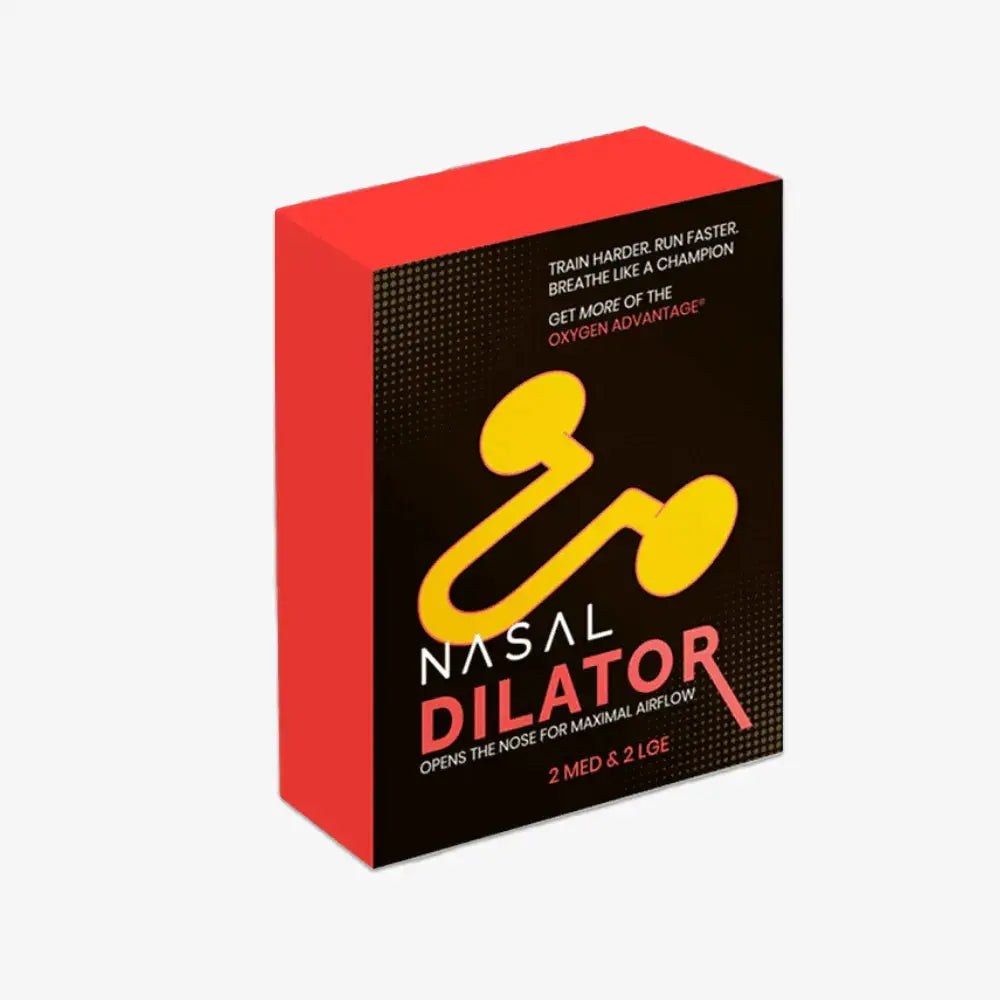
Nasal Dilator for Sport & Nasal Breathing – Pack of 4 (2 Medium, 2 Large)


Nasal Dilator for Sport & Nasal Breathing – Pack of 4 (2 Medium, 2 Large)
10,83 € excl. VAT. Local duties and taxes payable on delivery.
An internal nasal dilator that gently opens the nasal valve from the inside, so nose breathing takes less effort during exercise and daytime breathing practice. Designed by Patrick McKeown of Oxygen Advantage for sport, and just as useful if a narrow nose, a deviated septum or persistent congestion is what keeps sending you back to mouth breathing. Pack of four: two medium and two large. Each dilator lasts three to six months. Daytime use, not a sleep device.
10 in stock
Product Summary
Oxygen Advantage®
Nasal Dilator for Sport & Nasal Breathing
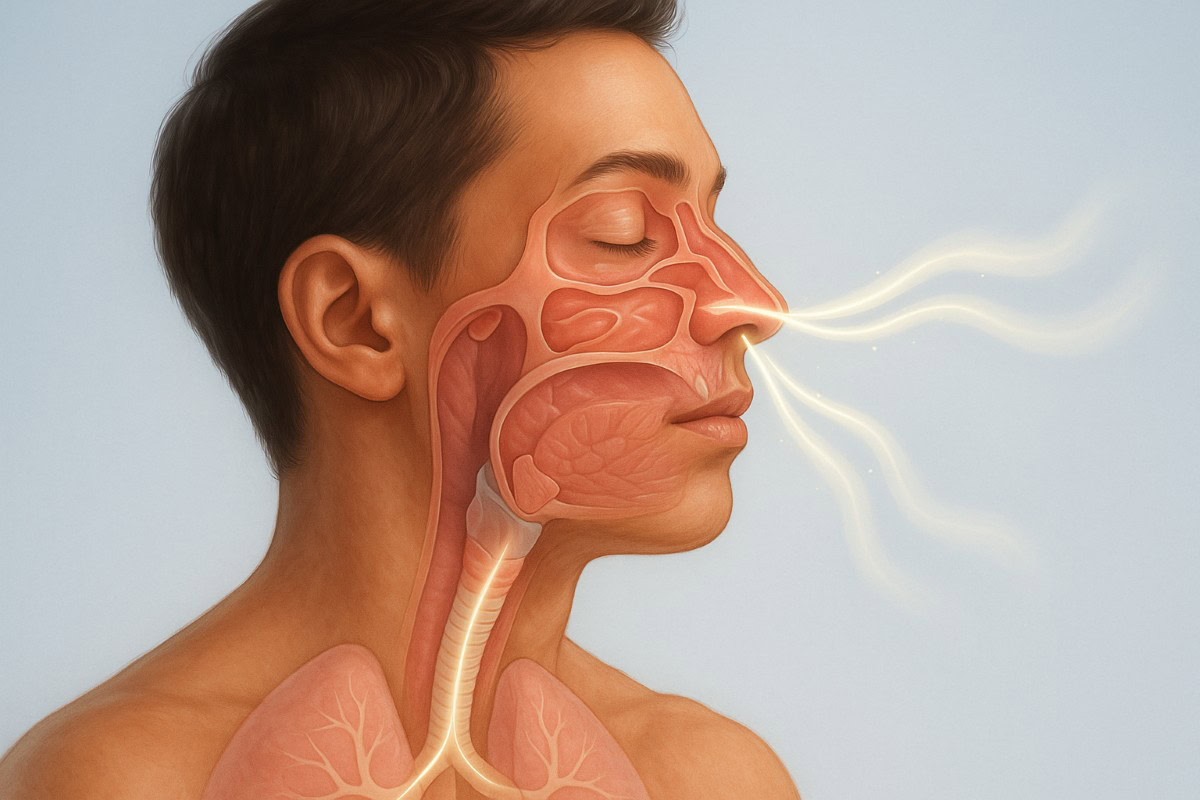
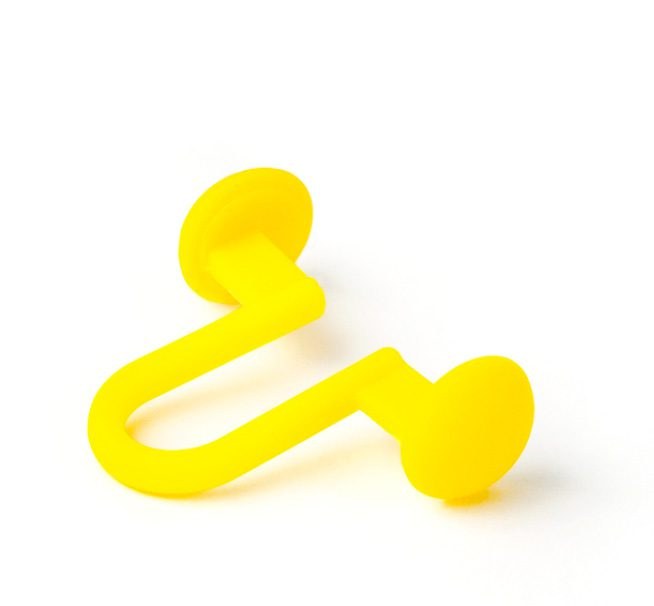
Nose breathing only works if air can actually get through. This internal nasal dilator sits inside the nostrils and holds the nasal valve open, the narrowest point of the whole airway, so breathing through your nose takes noticeably less effort. Built by Oxygen Advantage for training and sport, and just as useful if a narrow nose, a deviated septum or stubborn congestion is the reason you keep defaulting to your mouth.
Daytime device. This one is built for exercise and waking practice, not for sleep. If your goal is overnight nasal breathing, start with MyoTape instead.
The Gap
The part of nasal breathing you cannot practise your way out of
Almost everything we teach at Breathe First is trainable. Lip seal, tongue posture, breathing rate, the strength of the muscles that hold the airway open. All of it responds to practice. But none of it helps very much if the nose itself is simply too narrow to move enough air.
That is structural, not behavioural. Around 60% of the western population has some degree of septal deviation (de Oliveira et al., 2005). Nostril width varies genetically between populations from different climates (Zaidi et al., 2017). And people with smaller noses are measurably more likely to breathe through their mouths in the first place (Warren et al., 1988).
If you are one of them, willpower is not the missing ingredient. Airflow is. A nasal dilator does not retrain anything on its own, and it is not meant to. It removes the mechanical obstacle so the training you are already doing has somewhere to go.
The 30 second test
- Close your mouth and rest a fingertip on the outside of each nostril.
- Press gently outwards, pulling the nostrils slightly apart.
- Breathe in slowly through your nose.
Did the air move more freely? If so, a nasal dilator does the same thing mechanically, and holds it there while you train, work or exercise. If nothing changed, the restriction is probably higher up (turbinates or congestion) and a dilator is less likely to help.
How It Fits
Open, close, strengthen
Three things have to hold before nasal breathing becomes your default. The nose has to be open, the lips have to stay together, and the tongue has to sit up in the palate. Most people who stall are missing one of the three. Here is which tool does what.
Step 1
Open the nose
The Nasal Dilator widens the nasal valve mechanically. It works on the first breath, with no adaptation period, and comes out when you are done. Daytime and exercise.
This product
Step 2
Keep the lips together
MyoTape surrounds the lips and gently encourages them to stay closed overnight, without ever sealing the mouth. This is the one for sleep and snoring.
Step 3
Strengthen the airway
The REMplenish Myo-Nozzle turns every sip of water into a rep for the tongue and throat muscles that hold the airway open. No extra routine to remember.
Before any of them
Clear the nose first
A dilator opens a nose that is structurally narrow. It will not shift active congestion. The Buteyko nose unblocking exercise takes about two minutes and is worth doing before you fit a dilator, and before you judge whether it is helping.
Six reasons people reach for a nasal dilator
It targets the actual bottleneck
The internal nasal valve
The narrowest part of the nasal airway sits just inside the nostril, and it is where most inspiratory collapse happens. An internal dilator supports it directly rather than pulling on the skin outside.
Nasal breathing at higher effort
Past the point where you would normally open your mouth
Most people can nose breathe at an easy pace and lose it as intensity climbs. Reducing nasal resistance raises the effort level at which nose breathing still feels sustainable.
It unsticks stalled therapy
For myofunctional and Buteyko work
If you are doing the exercises and still cannot hold nasal breathing through the day, a narrow airway is a common reason why. This addresses that piece directly.
Something to try before surgery
A low-cost, reversible first step
A 2016 review of over-the-counter mechanical dilators concluded they may be an alternative to surgical intervention for some patients with nasal valve compromise (Kiyohara et al., 2016).
Nothing stuck to your face
No adhesive, no residue, no peeling off mid-run
Adhesive strips lift when you sweat and leave marks on the skin. An internal dilator sits inside the nose, holds position, and is barely visible.
Three to six months per dilator
Four in the pack
Wash with warm soapy water between uses. Two medium and two large means you can find your size, and have a spare of whichever one fits.
Internal vs External
Inside the nose, not taped across it

Adhesive strips such as Breathe Right pull outwards on the skin over the external valve. An internal dilator sits at the internal valve, the narrower of the two and the one that contributes far more to overall nasal resistance. That difference in position is why the two devices are not interchangeable, even though they are sold side by side.
| Internal dilator | Adhesive strip | |
|---|---|---|
| Acts on | Internal nasal valve | External valve, via the skin |
| Attachment | Held by shape, inside the nostril | Adhesive on the bridge of the nose |
| Sweat and humidity | Unaffected | Can lift and fail |
| Reusable | Yes, 3 to 6 months | No, single use |
| Visible | Only the small bridge | Yes, across the nose |
One caveat worth knowing: if you cannot get any air through your nose even after the unblocking exercise, neither device will fix that. See a clinician about the obstruction first.
Fitting
Getting the size and the position right
- Clear your nose first. Use the nose unblocking exercise, or at minimum blow your nose and give it a minute.
- Start with medium. Most adults fit medium. Try large if medium feels loose or shifts when you inhale hard.
- Insert with the bridge downward, so it spans the septum, the wall between your nostrils.
- Check the fit. Only the bridge should be visible. If the paddles are poking out, the size is too large for your nose.
- Build up gradually. Twenty minutes on an easy session first. Most people forget it is there within a week.
It should feel secure and slightly open, never stretched or pressured. There should be no pressure on the septum itself. If it hurts, it is the wrong size or the wrong position.
The Evidence
🧪 What the research actually says
Context Why so many people need one
Septal deviation is the norm, not the exception
de Oliveira et al., 2005
At least 60% of the western population has some degree of deviated septum. Most never know, and many simply adapt by breathing through the mouth.
Nose size predicts mouth breathing
Warren et al., 1988
People with smaller nasal airways are more likely to breathe orally, because the work of nasal breathing rises as the airway narrows.
Nostril width varies by ancestry
Zaidi et al., 2017
Nasal shape differs between populations adapted to different climates, so what counts as a comfortable nasal airflow is not the same for everyone.
Devices Evidence on mechanical dilators
Systematic review of over-the-counter dilators
Kiyohara et al., 2016, JAMA Facial Plastic Surgery
Reviewed 33 over-the-counter mechanical dilators and concluded that they may be an alternative to surgical intervention in some patients with nasal valve compromise. The authors noted that external strips and nasal clips are the best studied of the group.
Internal versus external, compared directly
Gelardi et al., 2019, Acta Biomedica
Compared an internal dilator against an adhesive strip in people who snore. The internal device reduced snoring time and improved sleep quality, and patients tended to prefer it to the strip. A small clinical-practice study rather than a large trial, so treat it as suggestive.
Sport Nasal breathing under load
Nasal breathing during exercise is learnable
Dallam and Kies, 2020
Exclusively nasal breathing is feasible for most people at moderate aerobic intensity without specific adaptation, and can extend to heavier work after a sustained period of practice. Performance may dip at first in people not yet adapted to it.
From the researcher
Professor George Dallam, exercise scientist and Olympic triathlon coach
"A nasal dilator can increase the work intensity achieved during exercise while breathing nasally."
Summary An honest read
The evidence for mechanical dilators is reasonable for nasal patency, which is what this device is for: they measurably reduce nasal resistance and increase peak nasal inspiratory flow. The evidence that this converts into a performance gain is thinner and genuinely contested, which is why we are not going to promise you a personal best. What a dilator reliably does is make nose breathing easier, so you can keep doing it for longer. Whether that changes your times is up to the rest of your training.
The Nasal Dilator is a self-care aid, not a medical device, and not a treatment for sleep apnoea, rhinitis or nasal obstruction. Studies cited above evaluate nasal dilators as a category rather than this product specifically. If you have persistent nasal obstruction, ongoing congestion, or symptoms of disordered breathing during sleep, please see your GP or an ENT specialist.

From the Founder
Emily Kirkcaldy
Founder & Lead Clinician at Breathe First
The commonest reason a myofunctional programme stalls is not effort. It is that the person physically cannot get enough air through their nose, so every time they concentrate on something else the mouth opens again. You can spend months on tongue posture and get nowhere while that is still true.
I like this device because it is honest about what it does. It does not train anything. It opens the nasal valve while it is in, and that is often enough to let the actual training take hold. I use it with clients during daytime practice and exercise, alongside MyoTape at night, and I ask them to do the unblocking exercise before they judge whether it is working.
Highly Specialist Speech & Language Therapist, Orofacial Myofunctional Therapist, Certified Buteyko Breathing Practitioner
In Their Words
What users say
Feedback collected by Oxygen Advantage from users of the Nasal Dilator.
Been really struggling with switching to nasal breathing when jogging, and in particular my breathing became really rapid and I had to slow down a lot. The dilator made a big difference. Much easier to nose breathe, and breathing was controlled and calmer.
Good to try 2 sizes, included in one pack.
Product Details
Everything you need to know
📦 What is in the pack
- 4 × internal nasal dilators
- 2 × medium, 2 × large
- Hard plastic core with a soft outer layer
- Patent pending design by Oxygen Advantage®
No adhesive, no batteries, nothing to replace except the dilators themselves.
🧼 Care & lifespan
- Wash with warm soapy water between uses
- Air dry fully before storing
- Replace every 3 to 6 months, sooner if discoloured or misshapen
- Do not boil, sterilise at high heat, or put in a dishwasher
- Inspect before each use and discard if cracked or split
⚠️ When not to use it
- Not during contact sport. No rugby, boxing, martial arts or anything with a risk of impact to the face, where breakage could injure the nose. Sprint and conditioning work is fine.
- Not designed for sleep. It is built to stay put during hard effort, which makes it less comfortable overnight than dedicated sleep dilators.
- Adults and older teenagers. Sizing is medium and large adult. Not suitable for young children.
- Not after recent nasal surgery, or with an active nasal infection or nosebleeds, unless your clinician says otherwise.
🤝 Pairs well with
- MyoTape for Adults, for lip seal overnight
- REMplenish Myo-Nozzle, to strengthen the airway muscles
- Buteyko breathing, for the nose unblocking exercise
- Nasal nitric oxide, why nose breathing is worth the trouble
📋 Specs at a glance
| Type | Internal nasal dilator (nasal valve dilator) |
|---|---|
| Pack contents | 4 dilators: 2 medium, 2 large |
| Materials | Hard plastic core with soft outer layer |
| Lifespan | 3 to 6 months per dilator |
| Wear time | Any number of hours during the day |
| Best for | Exercise, training, daytime nasal breathing practice |
| Not for | Sleep, contact sport, young children |
| Cleaning | Warm soapy water, air dry |
| Designed by | Patrick McKeown, Oxygen Advantage® |
| Shipping | Tracked Delivery, 3 to 5 working days |
❓ Frequently asked
How do I know if it is fitted correctly?
It should sit completely inside the nose with only the small bridge visible, spanning the septum. If the paddles are showing, the dilator is too large for your nose. It should feel secure and gently open, with no pressure on the septum and no pain.
Which size should I start with?
Start with medium, which fits most adults. Move to large if the medium feels loose or shifts when you breathe in hard. The pack contains two of each so you can test both and keep a spare.
Can I wear it in bed?
We would not recommend it. This dilator is engineered to stay put during intense exercise, and that firmness makes it less comfortable for a full night than dilators designed specifically for sleep. For overnight nasal breathing, MyoTape is the better tool.
Will it change the shape of my nose?
No. The widening lasts only while the dilator is in place. It supports nasal ventilation during use and has no lasting effect on the shape of your nose.
Is it better than nasal strips?
For most people, yes, because it acts on the internal nasal valve rather than the skin outside it, and the internal valve is the narrower point. In one clinical-practice comparison, an internal dilator reduced snoring time more than an adhesive strip and patients tended to prefer it (Gelardi et al., 2019). Strips still have a place if you cannot tolerate anything inside the nose.
Will it help my snoring?
Possibly, if a narrow nasal valve is part of your picture, but this particular dilator is not designed or sold as a sleep device and we do not recommend it for overnight use. Snoring has several possible causes. Our starting point for snoring is MyoTape and the REMplenish Myo-Nozzle.
Can children use it?
The pack contains medium and large adult sizes, so it is not suitable for young children. Older teenagers with adult-sized nasal passages can use it under adult supervision. For children who mouth breathe, please speak to us about a myofunctional assessment instead.
I still cannot breathe through my nose with it in. What now?
Try the nose unblocking exercise first, since a dilator opens a narrow nose but will not clear active congestion. If you still cannot move air after that, the restriction is likely higher in the nasal cavity, at the turbinates or from chronic rhinitis, and it is worth seeing your GP or an ENT specialist rather than persisting with a device.
Customer Reviews
No reviews yet. Be the first to share your experience!
Write a Review
Every approved review enters our monthly draw to win that product back: the price of one refunded, or 150% of that as store credit. One is the prize, however many you bought. Honest and descriptive is what we are after, good or bad. How the draw works.
Gallery
People also bought

We may earn an affiliate commission when you buy through links on our site.